Wednesday, December 15, 2010

Chicken Soup for the Bowl

Our LIFE class this week got a special treat; chicken soup! World renowned for its healing properties, chicken soup is a good remedy for many upper respiratory tract illnesses. Librarians Elise Sheppard and Jill Vu joined us to give us the Jewish and Vietnamese takes on this classic fare. Recipes below. Also below is a link explaining why chicken soup is so good for you. Our LIFE class left feeling fuller in wisdom and healthy goodness. Feel free to try one of these recipes at home with your family the next time cold and flu season comes around, or any day the week for a hearty and healthy meal.

Jewish Chicken Soup - AKA Jewish Penicillin
Rosely Himmelstein's winning recipe from Shabbat Across America's Chicken Soup Challenge
http://www.worldfamousrecipes.com/chicken-soup-winner.html
(Serves about 6)

Ingredients
•2 quarts of chicken broth (the recipe follows)
•1 chicken (about 3-4 lbs), quartered (I prefer a regular chicken to a fowl); rinsed
•1 large carrot, peeled and cup up
•1 large onion, peeled and cup up
•1 stalk celery
•1 leek, white and light green parts only; washed well
•1 parsnip, peeled and cut up
•1 parsley root, with greens attached
•1 sweet potato, peeled
•a handful of dill (about 3-4 stems)
•1 small rutabaga, peeled and cut up
•a few sprigs of cilantro (optional)
•Salt and pepper to taste

Directions:
•Put chicken broth in pot; bring to boil.
•Add chicken. Return to boil; lower heat.
•Gently simmer uncovered for 1 hour.
•Add the rest of the ingredients. Simmer for one-half hour more; stir occasionally.
•Skim fat from top.
•Pour into bowls; into each add a slice of carrot and a sprig of cilantro.
•If storing, let soup cool before refrigerating. When cold, remove the fat that rises to the surface. Use soup within 2-3 days, or store in freezer.

Vietnamese Chicken Soup

Ingredients:
•2 tbsp tamarind powder (optional)
•1/4 cup thinly sliced shallots
•1 tbsp oil
•1/2 tsp minced garlic
•1/2 tsp Asian chili paste or hot chili flakes
•5 cups fat-skimmed chicken broth
•1 lb chicken (or fish/shrimp)
•1 cup pineapple chunks
•2 tbsp Asian fish saucs (nuoc mam)
•3 tbsp sugar
•1/4 cup lime juice (6 tbsp if you don't use tamarind powder)
•2 tomatoes (6 oz. total) rinsed and cut into 1/2 inch wedges
•2 celery stalks or taro steam (sliced)
•2 cups (6 oz.) bean sprouts, rinsed and drained
•2 tbsp chopped fresh basil leaves
•2 tbsp chopped rice-paddy herb (ngo om) or fresh cilantro
•2 tsp finely chopped fresh chilies or chili garlic sauce

Directions:
•In a 5 to 6 quart pan over medium heat, stir shallots with oil until golden brown and crisp.
•Add garlic, chicken, and fish sauce to pan and stir until garlic is fragrant.
•Add broth, tamarind powder, sugar and bring to a boil over high heat.
•Add pineapple, tomatoes, and celery or taro steam.
•Cook uncovered just until chicken is cooked and simmered, 5-6 minutes.
•Add bean sprouts into hot broth.
•Ladle soup mixture into bowls and sprinkle with fried shallots, cilantro, basil, rice-paddy herb (ngo om) and chopped green onions. Add chilies to taste.

For more information on the therapeutic properties of chicken soup, go to http://chestjournal.chestpubs.org/content/118/4/1150.full.html


Check out this SlideShare Presentation:


Wednesday, December 8, 2010

A Sentimental Journey

"Hats off! Here they come, those beautiful girls. That's what you've been waiting for. Nature never fashioned a flower so fair. No rose can compare; nothing respectable, half so delectable. Cheer them in their glory, diamonds and pearls, dazzling jewels by the score. This is what beauty can be. Beauty celestial, the best, you'll agree: all for you, these beautiful girls!"

So begins Follies, a musical by Stephen Sondheim about showgirls and their families visiting the theater they used to perform in one more time before it is demolished. Sondheim is considered one of the best song writers/composers in the business, and this was the first time he had written both the lyrics and music for a show (having written the lyrics for West Side Story and Gypsy, among others). Over the years Follies has left critics divided, the harsher critics saying the piece is a large spectacle of songs over a non-existent plot, while more favorable critics point out that Follies is more a retrospective on the history of musical theater itself. Either way, Follies has enjoyed several revivals since its 1971 Broadway debut, and has many songs that are now standards including "Broadway Baby", "I'm Still Here, and "Loosing My Mind".

This week, our LIFE class got to enjoy a trimmed-down performance of Follies given by our Academy of Lifelong Learning: Acting for Seniors troupe. Professor Ron Jones directed these burgeoning thespians though brief but bright performances of the shows main musical numbers. The house was packed for both performances, and after the applause, we can only say "Bravo!"

And what are we to think as we go home? What is the takeaway from the night's performance? The meaning of the story is always up to the viewer, and critics are perpetually torn on the issue. I like to think we should all "Learn how to laugh. Learn how to love. Learn how to live." That's my tip. Good night folks!

Wednesday, December 1, 2010

Gifts In A Jar

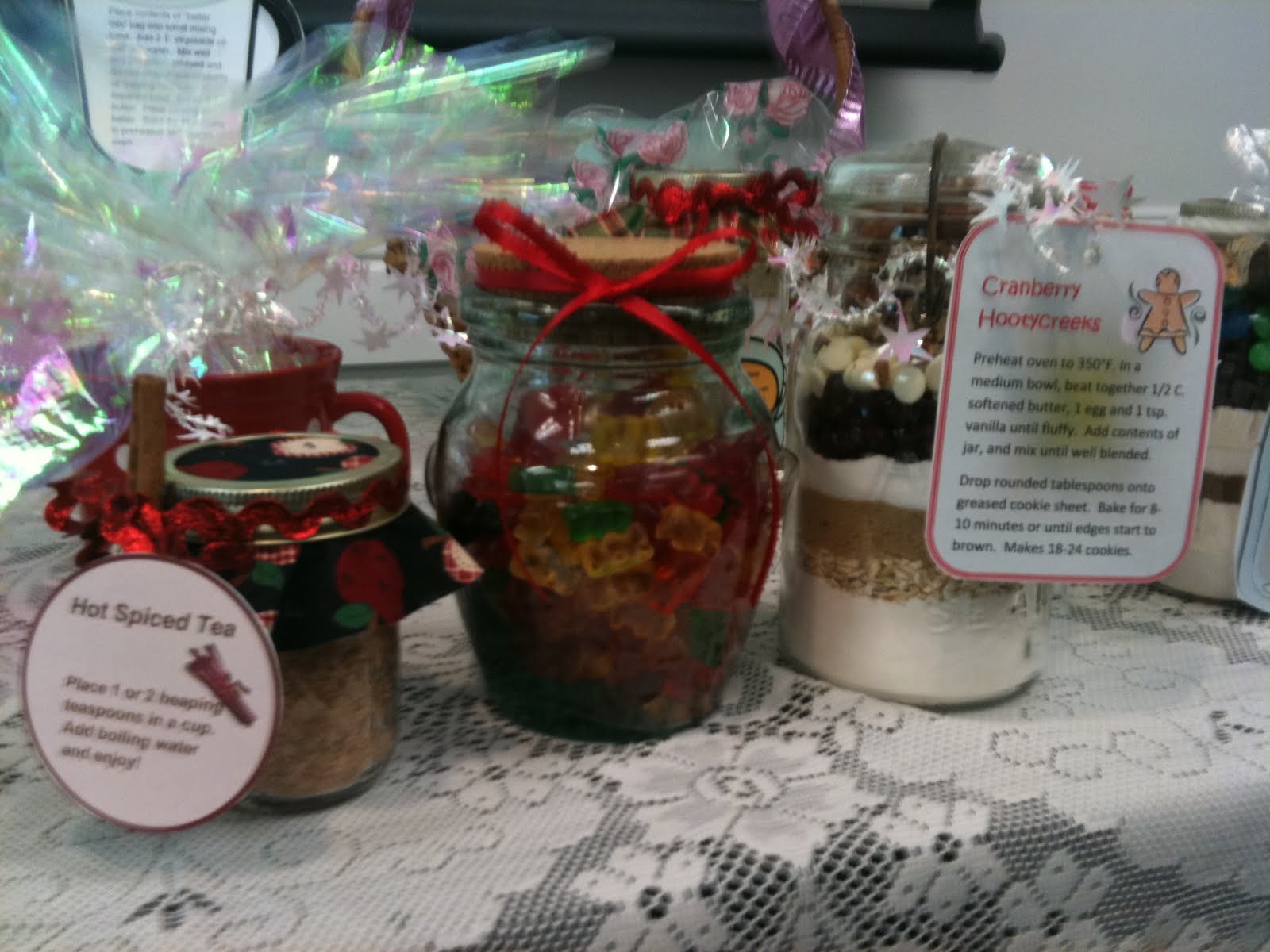
Seasons Greetings LIFEers! Just in time for the holidays, Librarian Patsy Brautigam joined us to share her ideas for gifts in a jar. Easy, fun, inexpensive and homemade; these gifts in a jar make great gift ideas for any time of year. This project does require an investment of time to assemble the jars, so it is best to make several jars at a time.

Jars: you can go to any craft store and buy mason jars and lids, or you can use leftover (and washed) spaghetti sauce jars. Be mindful: the recipes in this blog call for 1 quart jars, and sauce jars are usually larger. You'll need to do your math to convert the recipes.

Decorating Jars: you can let the beautiful filling be the decoration, or you can paint your jars. If you paint the jars, be sure to use latex paint. Paint only the outside, especially if the contents are for consumption. You can cut decorative cloth circles to fit between the parts of the lid, and tie it off with ribbon or raffia. You can also cut out little notes to attach to the jar with the cooking instructions, if the contents are food.

Filling Jars: make sure your jar is packed tight. Once the jars are filled, tap jar on a counter top several times to settle the contents. Then fill any extra space with wadded wax paper. The lid fabric will hide the paper.

Fun Stuff: get creative! Instead of a jar, use a tulip-style ice-cream sundae glass for bath beads or bath salts, top off with a loofah and a red bath bead to look like an ice-cream sundae. See photo below.

Jar Contents/Recipes: see the slide show below for the recipes we discussed in class!


Wednesday, November 17, 2010

Leadership and Virtue

Greetings LIFEers! We were joined once again this week by Professor Jason Moulenbelt for a class all incoming Congressmen should take; business ethics. Business ethics is a bit of an oxymoron, like jumbo shrimp or military intelligence. The two words just don’t seem to go together. But in this era of Enron, Tyco, BP, Wall Street, Magnetar, etc… a little refresher course on business ethics might be good for all of us.

If you take a business ethics class at a business school, you are more likely to study business law, not morality or ethics.
· Law – our democracy votes to make laws, which can have little to do with morality
· Ethos – what you do day-to-day, your actions
· Ethics – what you should do, morality
Example: Let’s say you are at a intersection with a stop sign and no one is coming from any direction. The law says you have to stop, but no one is coming, no one will be hurt or inconvenienced if you run the stop sign. If you break the law and run the stop sign, your actions are not immoral. But the spirit of the law is ethical – requiring people to stop at a crossing to avoid accidents and injuries. But many of our laws do not take ethics into account. Enron hiding their business dealings in phony companies was actually legal. Magnetar driving the sale of sub-prime mortgage CDOs while placing bets on their failure was also legal. So why are our laws seemingly not interested in morality?

First we need to understand utilitarianism, which is a principal many of our laws and economic system are based on. Utilitarianism is the idea that the greatest amount of good should be created for the greatest amount of people. The trouble is this theory measures happiness through money; every man will endure some amount of pain (work) for a certain amount of money. But this equation fails to take into account externalities; things you can’t put a price on. How much is your child’s smile worth, or a clean sunrise, or time with your family? At some point, utilitarian equations leave out our very humanity, which is what our ethics are based on – treating each other humanely.

Read Jason’s excellent slideshow below to see how this economic and law-making theory fails to take morality into account via the Ford Pinto. Also, check out ProPublica’s segment on the company Magnetar and its role in the housing bubble and wall street collapse here. http://www.propublica.org/article/all-the-magnetar-trade-how-one-hedge-fund-helped-keep-the-housing-bubble. You can also read the book or watch the film Smartest Guys in the Room which chronicles the rise and fall of Enron.

Aristotle said “in all things, moderation”, and this quote applies also to business ethics. Knowing that our business practices exclude the human element, remember to always look for the hidden externalities when putting together a cost-benefit analysis. You may find that the human costs are greater than you think.

Wednesday, November 10, 2010

Help the Honey Bees

What’s the buzz? I’ll tell you what’s a happenin’! (Jesus Christ Superstar reference, awesome musical.) Daniel Payne, local bee keeper, joined our LIFE class to talk about the not-so-secret life of bees and how we can help save the honey bees, and thus our own economy.

Did you know that most bee keepers make about half their money renting their bees? Many crops are pollinated by bees, so farmers rent bee colonies from bee keepers. Bees are trucked all over North America for this purpose. The big risk in bee transportation is overheating the colony. You see, a bee hive needs to stay at about 94° Fahrenheit for the larvae to survive, so the moving trucks need to be air conditioned or well ventilated to keep the bees alive. One hive can pollinate about 1 acre. California has 2 million acres of just almond trees (not to mention the numerous other crops pollinated by bees), so the bee rental business is very lucrative.

So why are bees important? Well, it turns out that bees are very hard workers and contributing greatly to our economy. They pollinate over 100 of the fruits and vegetables that we eat every day. Put another way, they are responsible for about ¼ of all the pollination work at an estimated value of $10 Billion per year. Without bees, we would have to pollinate these plants by hand, which means we would eat mostly grains. Food prices would soar, plants pollinated by bees would die off and so would the animals that feed on them. Would mankind survive? Probably. Would our entire world change for the worse? Absolutely.

So what is hurting the bees? Unfortunately, many things we are doing every day such as using pesticides and genetically modified crops harm the honey bees. Bees already have many natural parasites, which seem to be on the rise, especially Neonicotinoids are a common chemical in pesticides sold in the US. The pesticides become systemic in plants, so a bug lands on the plant, becomes paralyzed and dies within hours. The trouble is, it has a similar effect on bees. France and Spain have banned neonicotinoids, and other countries are considering a ban, because they believe the chemicals have contributed to massive bee colony deaths. Some genetically modified crops (such as BT corn) have naturally bug-resistant bacteria bred into the plant to make the plant bug resistant, but studies show this bacteria weakens the bees when they pollinate the plant, and makes the bees more susceptible to mites and other parasites.

That’s the bad news. So how can we help our industrious honey bees? First, you can start by using fewer lawn chemicals and pesticides that have neonicotinoids. That is tough because they are so common, but there are brands available. Check the labels. Second, buy local honey. The US imports millions of pounds of honey each year; clearly we are not supplying enough honey to meet demand. Buying local honey helps the US honey industry and keeps your local bee keepers in business. Again, read the labels on the shelf. There are even imitation honey brands available now. The label should say “pure honey” and made locally, or made in Texas, etc… Unfortunately, local honey does not necessarily help out with allergies, as the rumor suggests. Bees pollinate fruits and vegetables, so if you are allergic to local fruits and veggies, then yes, local honey can help offset your allergies, since you will be ingesting small doses of those pollens. But if you are allergic to trees, grass and molds, you are out of luck as bees don’t pollinate any of those plants. Third, grow a bee garden in your yard. Check out http://www.helpthehoneybees.com/#helpgarden for which plants are bee friendly.

With a little effort, we can help our hard working honey bees and keep our economy buzzing along!

Wednesday, November 3, 2010

Graveyards and Genealogy

Have you ever noticed how many ways there are to say someone has died, without actually having to say some form of the word “dead”? They have passed on, gone to a better place, met their maker, bought the farm, kicked the bucket, bit the dust, cashed in their chips, pushing up daisies, their number is up, riding the pale horse, six feet under, sleeping with the fishes, taking a dirt nap, shuffled off this mortal coil, etc… Maybe we, as a society, are afraid to talk about death. Or maybe we just like to find clever ways to say the same old thing.

But our LIFE class isn't afraid to talk about death, or even loving the dead (as Claire hilariously stated – maybe we’ll have a class on that later, or maybe not). Library Director Mick Stafford hosted this week’s LIFE class, all about Graveyards and Genealogy, a topic that might have bored us stiff if Mic hadn’t knocked us dead with his grave humor. (Nudge, nudge, wink wink.) See, Mic isn’t the only one who can make bad puns about death. (For more bad puns about death, check out our earlier LIFE blog on the National Museum of Funeral History.)

You see, sometimes when you are researching your genealogy, you reach a dead end. (I’ve got a whole bag of these puns, folks). Maybe you are searching for a death record or a burial site. Maybe you are looking for an obituary. Or maybe you are just trying to find out about the lives of the people who made you eat peanuts with a spoon while sitting on plastic covered furniture when you were a dirty little kid. Gather as much information as you can; death date, death location (city, state, county) and start searching the web. But you don’t need to spend an eternity searching the web; links to helpful websites are below.

Ancestry.com – church records, obituaries, state death indexes, some international records
Legacy.com – find obituaries, may charge you
Internment.net – search for a grave site
Findagrave.com – search for a grave site, and Mic’s personal favorite!
http://www.usgwtombstones.org/ - US GenWeb Tombstone Project -
AfricanAmericanCemetaries.com
Gravelocator.cem.va.gov - find the grave site of a US Veteran
http://www.abmc.gov/home.php - find the grave site of a US Veteran overseas
Library Databases - use the newspaper database or access archives database


Check out this SlideShare Presentation:

Wednesday, October 27, 2010

Food Carving Magic

The season of joy, sharing, and goodwill toward me is upon us and you know what that means - start cleaning your house now for all the parties you are going to have. It also means you are probably going to be cooking (and eating, and eating while you cook) a lot. This year, rather than serving the same old veggie plate that always serve, try "sprucing" it up by incorporating some food carving into the mix. This week our LIFE class was joined by Jackie Barnhart who taught us how to turn our veggies into flowers and other fun shapes.

To do any type of food carving, you will probably need a small knife; one that you can hold in your hand easily and control well. For some effects you can use a fork or a plastic carving tool.

We started with radishes. To make a rose, score a star of david shape into one side of the radish cutting down not quite halfway. Soak the radish in ice water to make it bloom. It takes about an hour for the radish to open. If you cut several lines across the radish, all in one direction, it makes a shape similar to a chrysanthemum. Or you can carefully use you knife point to cut out little circles and make ladybugs. (See photo below.)

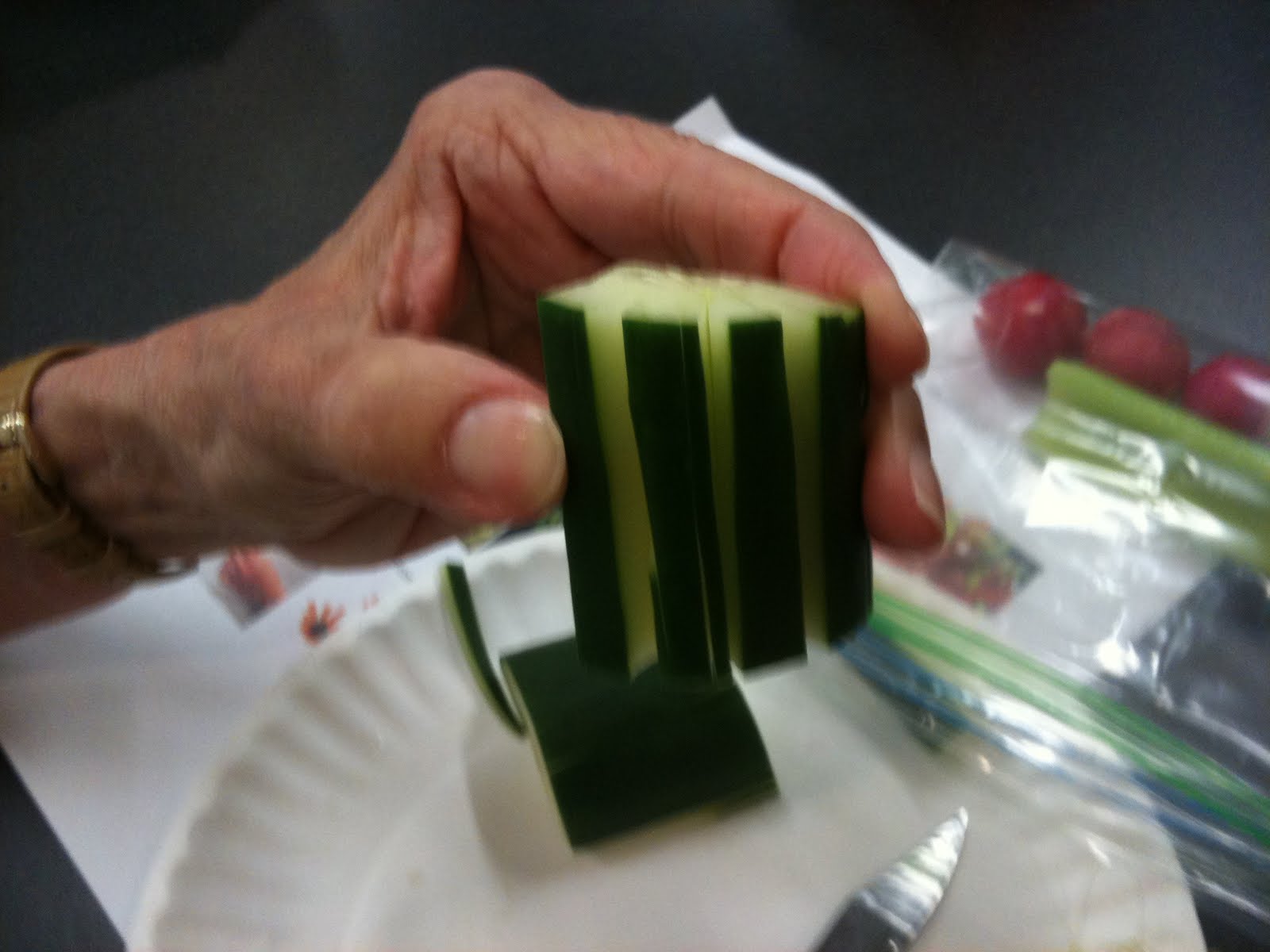
Cucumber, zucchini, yellow squash: you can score down the length of the vegetable with a fork to make a frilled appearance, once the vegetable is sliced. (See photo.) Or you can cut deep notches down the length of the vegetable to make your slices look like flowers.

When carving, be sure to take color into account. Green, red and yellow bell peppers make a colorful addition to any party tray. Cut the tops off, gently scoop out the seeds and stringy insides and fill the pepper with cream cheese, sour cream or any other dip. Celery stalk heads (the fluffy leafy part) make great standing decorations.

For more information, check out these websites.
http://www.passion-for-parties.com/vegetable-garnish.html
http://johnpoon.org/garnishes.html
http://www.youtube.com/watch?v=L7ugWHJDtm8 (see the right side of the screen for more videos of food carving ideas)
http://flavorsofkentucky.wordpress.com/2008/07/01/make-a-watermelon-turtle-for-a-fourth-of-july-party/
http://recipes.howstuffworks.com/tools-and-techniques/how-to-garnish-cooking6.htm