Wednesday, September 1, 2010

From Fantasy Coffins to Funerals of the Famous

Greetings LIFEers! This week's class was a grave history in funeral and burial history. Our instructor was Lucy Gonzales, from the National Museum of Funeral History here in Houston. Our parking situation is crazy here at the college, due to the start of the semester and all the construction, so she was a little late, but fortunatly not late....get it? Late. Just a little funeral humor to get you going. Not funny? Hmm, usually knocks them dead at the funeral home....ba da bum. Anyone, anyone? Man, this crowd is a bunch of stiffs.......okay, I'll stop.

So, burial history. Fascintating subject. Did you know back in the 1800s and 1900s that many funerals were held in the home? The funeral director would come to your house, clear out your living room and bring all the necessary furniture to display the body. A family member sat with the body day and night until the burial. Families were required to wear mourning colors (usually black, although white is also a traditional color worn to funerals) for 2 years after the death of a loved one. After 2 years they could wear a little beige color around the cuffs and collar. They could return to regular clothes after 4 years. Imagine that, 4 years of wearing mostly black. While very slimming, it seems like it would become depressing, especially with higher mortality rates in those days. Some folks could wear black for decades. Queen Victoria, so distraught over her husband Prince Albert's death, wore black for the rest of her life (40 years), although she disliked black funerals, so for her funeral London was decorated in purple and white.

Now the ancient Egyptians embalmbed their dead, and we still do today, but we use modern(ish) techniques. Embalming is mostly a Christian/western practice today. Traditional Jewish law and Islamic law forbids embalming and encourages burial within 24 hours of the death, if possible, and Hinduism discourages embalming. As we learn more about the toxicity of formaldehyde (probable carcinogin), more and more people are choosing not to be embalmed. The embalming process is really for the living, to better present the deceased to loved ones, who can more easily grieve for the deceased if they appear more life like. The last decade has seen the rise of green funerals; deceased not being embalmed, and being burried in biodegradable caskets under trees instead of tombstones.

For more information on the history of funerals, including presidential and papal memorabilia, visit the National Museum of Funeral History, off I-45 between Airtex and Richie. http://www.nmfh.org/

Check out this SlideShare Presentation:

Wednesday, August 25, 2010

An Unexamined Life

Why do you do what you do? In a multi-verse of infinite possibilities, are you doing this because it is what everyone around you is doing, or because this is the choice you would genuinely make, even in a vacuum? I often ask myself this question when I see a woman with a really ugly purse. Does she really like that purse, or did she buy it because the fashion magazines declared that purse to be the "it-bag" of the moment and she is trying to squeeze herself into other people's perceptions of cool, trendy and popular? Of course, this question is not just handy in identifying stupid fashion trends. Applied on a broader scale it helps us understand our own behaviors by making us confront how we make decisions. And this, my fellow LIFEers is the basis of philosophy, a subject we had a teasing glimpse into by Professor Mark Thorsby this week.

"The unexamined life is not worth living." So said Socrates, in Plato's Dialogues, Apology. Professor Thorsby took us through his views on how 3 famous philosophers would address that statement. Kierkegaard, a Danish philosopher in mid 1800s, focused mainly on the ideas of the subjectivity of truth, and faith. Kierkegaard would argue that an unexamined life is ultimately an ignorant and dogmatic life, because the person never questioned the world around them and accepted the "truths" given to them by society. Next, Karl Marx, a German philosopher in the mid 1800s, applied philosophy to socio-economic struggles and determined that working classes are alienated from their true nature because they don't own their work. Marx would have responded to Aristotle by saying an unexamined life is an alienated life, that until you realize you have no ownership over your work (your ability to transform the world) you are removed from your true potential. Lastly, Friedrich Nietzsche, a German philosopher in the late 1800s, who believed that morality evolves with society. Nietzsche would say that the unexamined life is a common life, one lived with the herd, never challenging the social norms. The examined life is radical, untethered from assumptions.

"So what should we do?" you ask. Are we supposed to question our every action? Why do I brush my teeth, why did I buy a blue Honda Odyssey, should I obey this stop sign if no one is coming the other way? The answer is "yes". No, there is no ultimate answer, and the answers that do come will be as varied as the people who ask the questions. But if there is no ultimate answer, why bother asking the question, and isn't saying there is no ultimate answer an ultimate answer itself? And if the answer varies by the individual experience, then truth is completely subjective, thus negating the idea of "truth" at all, right? Uggh, my brain hurts from all this heavy thinking. I think I'll watch some TV. Now which channel should I watch? Wait, should I even ask that question? Does the fact I'm asking that question have any meaning? Arghhhhh!!!

Wednesday, August 18, 2010

Touring Taste of Dance Salad Festival

The artists Mary Cassatt and Edgar Degas disagreed about style. Degas believed a good painting needed a pretty subject. Cassatt believed that composition was most important and to prove her point, she composed a painting of a servant girl at her toilette, titled Girl Arranging Her Hair. The model is not a classical beauty by any means, but the painting is fascinating none the less. The beauty of the picture comes from the rigor of the composition, the angles of the girls arms and braid to the furniture behind her, and the gentle contrast of colors. Degas conceded the point.


So what does this have to do with dance, you ask? Everything! For those not well-studied in dance, the general thought is that dance is all about (traditional ideas of) beauty; the movement, the music, the costumes, even the dancers themselves, etc... Not so! Just as Cassatt proved in painting, what makes dance really fascinating is how the dance uses the space; the contrasting angles formed by the dancers; and how lighting, costumes, music and even props can help tell the story. In this week's LIFE class we watched a movie of some of the dances performed at Houston's Taste of Dance Salad Festival.


Unfortunately we cannot show the movie we watched in class this week on the blog, so you will need to take my word for how interesting and enjoyable it was. The class favorites seemed to be a dance by Mats Ek and his wife (both in their 60s, proving that dance is for all ages, not just skinny 20 somethings) and the dance of a woman going about her day, with a male dancer enacting all the objects she comes in contact with. Watching him become clothing, jewelry, food, a phone, and (class favorite) high heels through dance was amazing. See the links below for the 2011 Dance Salad Festival, and check out dance events here at Cy-Fair too.


Houston's Dance Salad web page: http://www.dancesalad.org/community.shtml


Mary Cassatt's Girl Arranging Her Hair: http://www.nga.gov/collection/gallery/gg83/gg83-46572.html

Wednesday, August 11, 2010

"If it Ain't Got That Swing"

Hey all you hep cats and smokin' sluggers! Hope you caught our LIFE class this week giving the low-down on black baseball and music in the Jim Crow era. Dr. Larry Hogan, Senior Professor of History at Union College and Dr. Robert Cvornyek, Professor of History at Rhode Island College laid it all on us, right where it all was. Their gig was so solid, I don't really need to break it down for you, ya dig? Check out their presentation, while I take five. Keep it cool....

Only The Ball Was White

http://www.nytimes.com/1981/02/16/arts/tv-only-the-ball-was-white.html

Wednesday, August 4, 2010

Cypress Once Had a Rodeo and a Hot Artesian Well

Greeting LIFErs! This week we were joined by Jane Ledbetter and Karen McGilvery from the Cypress Historical Society to give us the history of the Cypress area and a virtual walk-through of Cypress Top Historical Park.

We believe Cypress got its name from the numerous Cypress tress that lined the banks of the bayous at the time, although none remain today. Cypress looked very different in the 1700-1800s: there were few trees as the area was mostly prairie. Cypress remained mostly unincorporated farmland until mid 1840s when the first stage coach lines and Post Office developed. When Texas became the 28th state in 1845, Cypress began to grow due to a large influx of mostly German immigrants, who gave their family names to streets which still exist today.

In 1856 a railroad was built from Houston to Cypress, and the first locomotive was affectionately named "Ebenezer". But the area never really grew, as yellow fever, diphtheria, and other illnesses took a toll on the population until 1897 when Ed Juergen helped develop the community. He built the "Tin Hall" (a dance hall and gun & rifle club) and also the Juergen store, both of which survive today. In 1910, while drilling for oil they instead discovered hot water, and town had 2 hot pools and 1 cold pool which attracted folks from all over the Houston area. The Cypress rodeo began in 1944, mostly for goat roping, but it grew into a full-fledged rodeo quickly.

Please look through the slide show below to learn more about our town's history, and check out the Cypress Historical Society and Cypress Top Historical Park when you have the chance. It is also time to register for the next year of the Academy of Lifelong Learning. See the links below.

Cypress Historical Society: http://www.cypresshistoricalsociety.com/Home.html
Cypress Top Historical Park: http://www.co.harris.tx.us/Pct3/parks/cypresstophistoric.aspx
Academy of Lifelong Learning: http://www.lonestar.edu/cyfair-all.htm

Wednesday, July 28, 2010

Empanadas of Argentina

¡Buenos días! LIFEers showed up hungry for today's class on making Argentinian empanadas. "Empanada", as it is written in Spanish and Portuguese, or "impanata" in Italian, derives from the verb "empanar" meaning "to wrap in bread". Thus, empanadas are small bread pastries surrounding some type of filling, which varies by region. Mexican empanadas usually contain a fruit filling whereas Italian impanatas often contain cheese and/or vegetables. The Argentinian empanadas we made in class contain ground beef and green olives.

Empanada recipe
• 1 onion, chopped
• 1 pound ground beef (not lean)
• 2 teaspoons paprika
• 1/2 teaspoon crushed red pepper flakes
• 1 teaspoon ground cumin
• 1/2 cup pitted green olives, chopped (10 oz jar)
• 2 cloves garlic chopped
• 1 egg
• 2 packages of frozen empanada dough (1 package has 16 dough slices)

Brown the ground beef with the chopped onions and garlic on low heat, adding the spices when it begins to brown. Add the olives. Since the meat will continue to cook in the empanada, don’t cook it thoroughly in the pan. Let it cool. Spoon a small amount of the meat mixture onto the center of a thawed empanada dough slice. Fold the dough over the meat like a taco. Pinch one end closed to hold the juices inside. Then pinch the entire top of the empanada closed, using a pie-crust-like pinching technique. Brush the sealed empanada with egg. Bake in the oven at 425 for 15 minutes or until golden brown. Serve plain or with hot sauce. Makes 32 empanadas.

You can buy the frozen dough at Phoenicia.
http://www.phoeniciafoods.com

To try empanadas around Houston, visit these locations:
• Manenas Deli - http://www.manenas.net/

• Asturias Bakery - http://www.insiderpages.com/b/15245358248/asturias-bakery-houston

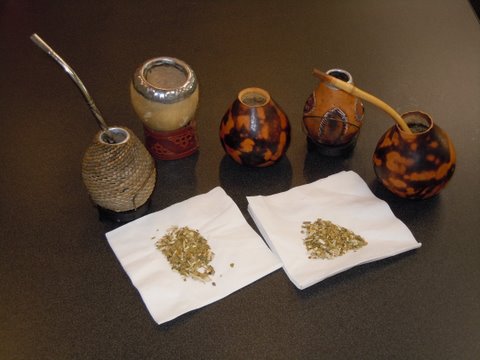
We also learned about Yerba Mate tea, a popular beverage of the gauchos, which is rumored to be healthy and help you loose weight, but is also supposedly tied to increased incidents of throat cancer in the gauchos that drank it daily. Todo en moderación, I always say. The gauchos drank the tea in little wooden cups, of which we had several examples in class. ¡Hasta luego!


Wednesday, July 21, 2010

Playing in Shadows: Negro Leagues in Texas

Play ball! Today's LIFE workshop attendees were in the cat-bird seat for a major triple header. First up to bat was Author Robert Fink who gave us a thorough history of the Negro Leagues. From weekend past-time to full-time touring job, many of baseball's finest swung for the fences without ever going pro. Not until the 1950's did the pros start hiring players away and the leagues one-by-one folded. Trivia time: of Texas' 13 players in the Hall of Fame, how many are African American? Answer later in the blog, so you'll have to keep reading.

Next to step up to the plate was Gary Crawford, operator of NegroLeagueLegends.org. Gary specializes in following up on our remaining Negro League players and is working towards getting these major contributors to American history recognized by the MLB and the White House.

And just to make sure today's workshop was a grand slam, we were joined by Johnny "Lefty" Washington of the Houston Eagles . Lefty regaled us with many tales, including the time he hit Willie Mays with a ball in the ribs, the reason behind Ted "Double Duty" Radcliffe's other nickname, and stories of serving with the US Marines in Korea. Listening to Lefty speak, we were filled with nostalgia for the way the game used to be played, before rigid rules and steroids. As Lefty said about today's players, "they're larger, but not better." It was an honor and privilege to listen to an American patriot and living legend.

The answer to the trivia question above is 9. Below are links to books on the Negro Leagues and Gary Crawford's website. I think that just about covers all the bases. For more information on the history of African Americans to baseball, check out the Library's exhibit "Pride and Passion: The African American Baseball Experience". We have events going on from July 14 - August 27.


Featured book "Playing in Shadows":