Wednesday, November 17, 2010

Leadership and Virtue

Greetings LIFEers! We were joined once again this week by Professor Jason Moulenbelt for a class all incoming Congressmen should take; business ethics. Business ethics is a bit of an oxymoron, like jumbo shrimp or military intelligence. The two words just don’t seem to go together. But in this era of Enron, Tyco, BP, Wall Street, Magnetar, etc… a little refresher course on business ethics might be good for all of us.

If you take a business ethics class at a business school, you are more likely to study business law, not morality or ethics.
· Law – our democracy votes to make laws, which can have little to do with morality
· Ethos – what you do day-to-day, your actions
· Ethics – what you should do, morality
Example: Let’s say you are at a intersection with a stop sign and no one is coming from any direction. The law says you have to stop, but no one is coming, no one will be hurt or inconvenienced if you run the stop sign. If you break the law and run the stop sign, your actions are not immoral. But the spirit of the law is ethical – requiring people to stop at a crossing to avoid accidents and injuries. But many of our laws do not take ethics into account. Enron hiding their business dealings in phony companies was actually legal. Magnetar driving the sale of sub-prime mortgage CDOs while placing bets on their failure was also legal. So why are our laws seemingly not interested in morality?

First we need to understand utilitarianism, which is a principal many of our laws and economic system are based on. Utilitarianism is the idea that the greatest amount of good should be created for the greatest amount of people. The trouble is this theory measures happiness through money; every man will endure some amount of pain (work) for a certain amount of money. But this equation fails to take into account externalities; things you can’t put a price on. How much is your child’s smile worth, or a clean sunrise, or time with your family? At some point, utilitarian equations leave out our very humanity, which is what our ethics are based on – treating each other humanely.

Read Jason’s excellent slideshow below to see how this economic and law-making theory fails to take morality into account via the Ford Pinto. Also, check out ProPublica’s segment on the company Magnetar and its role in the housing bubble and wall street collapse here. http://www.propublica.org/article/all-the-magnetar-trade-how-one-hedge-fund-helped-keep-the-housing-bubble. You can also read the book or watch the film Smartest Guys in the Room which chronicles the rise and fall of Enron.

Aristotle said “in all things, moderation”, and this quote applies also to business ethics. Knowing that our business practices exclude the human element, remember to always look for the hidden externalities when putting together a cost-benefit analysis. You may find that the human costs are greater than you think.

Wednesday, November 10, 2010

Help the Honey Bees

What’s the buzz? I’ll tell you what’s a happenin’! (Jesus Christ Superstar reference, awesome musical.) Daniel Payne, local bee keeper, joined our LIFE class to talk about the not-so-secret life of bees and how we can help save the honey bees, and thus our own economy.

Did you know that most bee keepers make about half their money renting their bees? Many crops are pollinated by bees, so farmers rent bee colonies from bee keepers. Bees are trucked all over North America for this purpose. The big risk in bee transportation is overheating the colony. You see, a bee hive needs to stay at about 94° Fahrenheit for the larvae to survive, so the moving trucks need to be air conditioned or well ventilated to keep the bees alive. One hive can pollinate about 1 acre. California has 2 million acres of just almond trees (not to mention the numerous other crops pollinated by bees), so the bee rental business is very lucrative.

So why are bees important? Well, it turns out that bees are very hard workers and contributing greatly to our economy. They pollinate over 100 of the fruits and vegetables that we eat every day. Put another way, they are responsible for about ¼ of all the pollination work at an estimated value of $10 Billion per year. Without bees, we would have to pollinate these plants by hand, which means we would eat mostly grains. Food prices would soar, plants pollinated by bees would die off and so would the animals that feed on them. Would mankind survive? Probably. Would our entire world change for the worse? Absolutely.

So what is hurting the bees? Unfortunately, many things we are doing every day such as using pesticides and genetically modified crops harm the honey bees. Bees already have many natural parasites, which seem to be on the rise, especially Neonicotinoids are a common chemical in pesticides sold in the US. The pesticides become systemic in plants, so a bug lands on the plant, becomes paralyzed and dies within hours. The trouble is, it has a similar effect on bees. France and Spain have banned neonicotinoids, and other countries are considering a ban, because they believe the chemicals have contributed to massive bee colony deaths. Some genetically modified crops (such as BT corn) have naturally bug-resistant bacteria bred into the plant to make the plant bug resistant, but studies show this bacteria weakens the bees when they pollinate the plant, and makes the bees more susceptible to mites and other parasites.

That’s the bad news. So how can we help our industrious honey bees? First, you can start by using fewer lawn chemicals and pesticides that have neonicotinoids. That is tough because they are so common, but there are brands available. Check the labels. Second, buy local honey. The US imports millions of pounds of honey each year; clearly we are not supplying enough honey to meet demand. Buying local honey helps the US honey industry and keeps your local bee keepers in business. Again, read the labels on the shelf. There are even imitation honey brands available now. The label should say “pure honey” and made locally, or made in Texas, etc… Unfortunately, local honey does not necessarily help out with allergies, as the rumor suggests. Bees pollinate fruits and vegetables, so if you are allergic to local fruits and veggies, then yes, local honey can help offset your allergies, since you will be ingesting small doses of those pollens. But if you are allergic to trees, grass and molds, you are out of luck as bees don’t pollinate any of those plants. Third, grow a bee garden in your yard. Check out http://www.helpthehoneybees.com/#helpgarden for which plants are bee friendly.

With a little effort, we can help our hard working honey bees and keep our economy buzzing along!

Wednesday, November 3, 2010

Graveyards and Genealogy

Have you ever noticed how many ways there are to say someone has died, without actually having to say some form of the word “dead”? They have passed on, gone to a better place, met their maker, bought the farm, kicked the bucket, bit the dust, cashed in their chips, pushing up daisies, their number is up, riding the pale horse, six feet under, sleeping with the fishes, taking a dirt nap, shuffled off this mortal coil, etc… Maybe we, as a society, are afraid to talk about death. Or maybe we just like to find clever ways to say the same old thing.

But our LIFE class isn't afraid to talk about death, or even loving the dead (as Claire hilariously stated – maybe we’ll have a class on that later, or maybe not). Library Director Mick Stafford hosted this week’s LIFE class, all about Graveyards and Genealogy, a topic that might have bored us stiff if Mic hadn’t knocked us dead with his grave humor. (Nudge, nudge, wink wink.) See, Mic isn’t the only one who can make bad puns about death. (For more bad puns about death, check out our earlier LIFE blog on the National Museum of Funeral History.)

You see, sometimes when you are researching your genealogy, you reach a dead end. (I’ve got a whole bag of these puns, folks). Maybe you are searching for a death record or a burial site. Maybe you are looking for an obituary. Or maybe you are just trying to find out about the lives of the people who made you eat peanuts with a spoon while sitting on plastic covered furniture when you were a dirty little kid. Gather as much information as you can; death date, death location (city, state, county) and start searching the web. But you don’t need to spend an eternity searching the web; links to helpful websites are below.

Ancestry.com – church records, obituaries, state death indexes, some international records
Legacy.com – find obituaries, may charge you
Internment.net – search for a grave site
Findagrave.com – search for a grave site, and Mic’s personal favorite!
http://www.usgwtombstones.org/ - US GenWeb Tombstone Project -
AfricanAmericanCemetaries.com
Gravelocator.cem.va.gov - find the grave site of a US Veteran
http://www.abmc.gov/home.php - find the grave site of a US Veteran overseas
Library Databases - use the newspaper database or access archives database


Check out this SlideShare Presentation:

Wednesday, October 27, 2010

Food Carving Magic

The season of joy, sharing, and goodwill toward me is upon us and you know what that means - start cleaning your house now for all the parties you are going to have. It also means you are probably going to be cooking (and eating, and eating while you cook) a lot. This year, rather than serving the same old veggie plate that always serve, try "sprucing" it up by incorporating some food carving into the mix. This week our LIFE class was joined by Jackie Barnhart who taught us how to turn our veggies into flowers and other fun shapes.

To do any type of food carving, you will probably need a small knife; one that you can hold in your hand easily and control well. For some effects you can use a fork or a plastic carving tool.

We started with radishes. To make a rose, score a star of david shape into one side of the radish cutting down not quite halfway. Soak the radish in ice water to make it bloom. It takes about an hour for the radish to open. If you cut several lines across the radish, all in one direction, it makes a shape similar to a chrysanthemum. Or you can carefully use you knife point to cut out little circles and make ladybugs. (See photo below.)

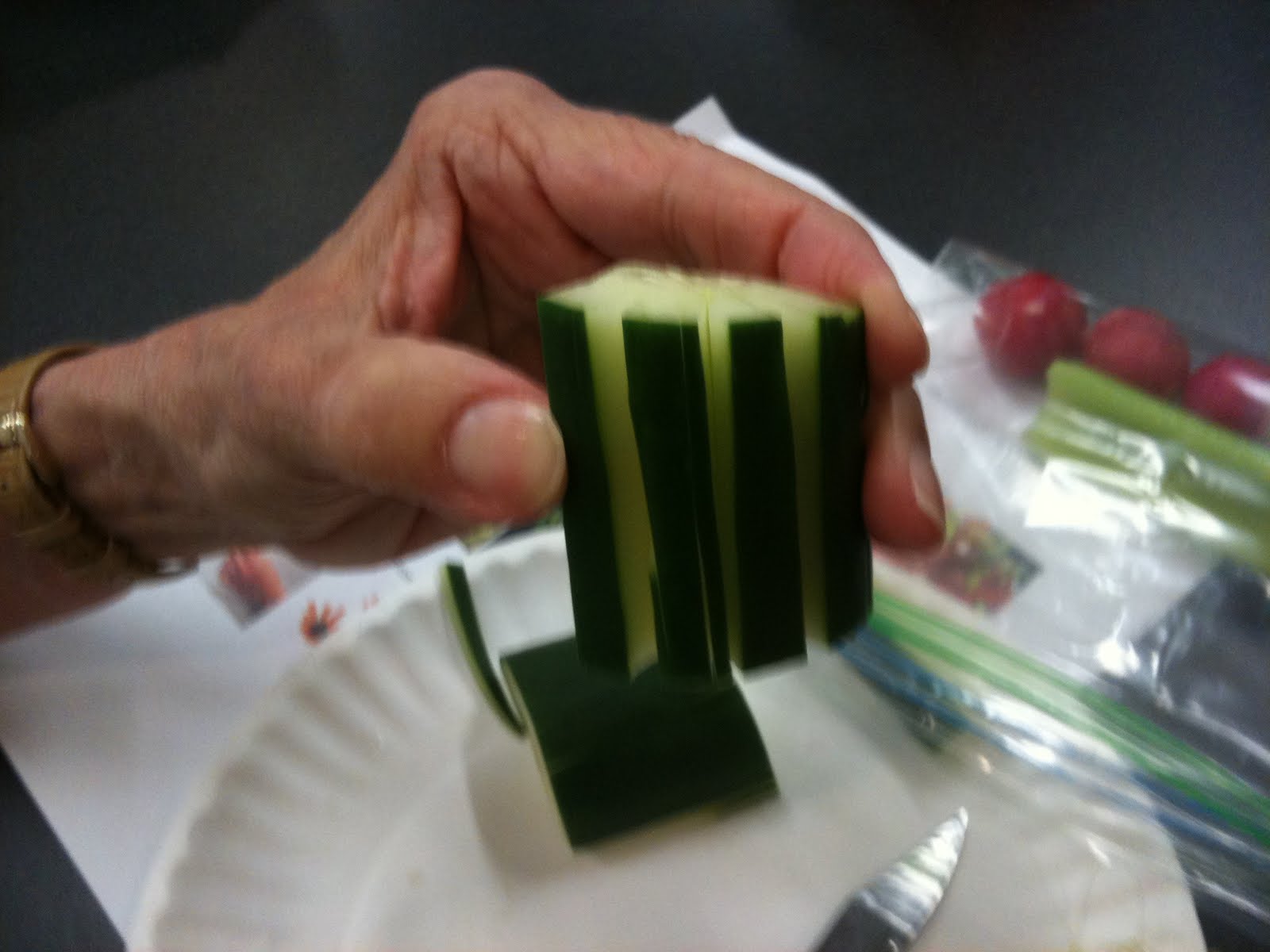
Cucumber, zucchini, yellow squash: you can score down the length of the vegetable with a fork to make a frilled appearance, once the vegetable is sliced. (See photo.) Or you can cut deep notches down the length of the vegetable to make your slices look like flowers.

When carving, be sure to take color into account. Green, red and yellow bell peppers make a colorful addition to any party tray. Cut the tops off, gently scoop out the seeds and stringy insides and fill the pepper with cream cheese, sour cream or any other dip. Celery stalk heads (the fluffy leafy part) make great standing decorations.

For more information, check out these websites.
http://www.passion-for-parties.com/vegetable-garnish.html
http://johnpoon.org/garnishes.html
http://www.youtube.com/watch?v=L7ugWHJDtm8 (see the right side of the screen for more videos of food carving ideas)
http://flavorsofkentucky.wordpress.com/2008/07/01/make-a-watermelon-turtle-for-a-fourth-of-july-party/
http://recipes.howstuffworks.com/tools-and-techniques/how-to-garnish-cooking6.htm

Wednesday, October 20, 2010

Changcheng: The Great Wall of China

Ni hao, LIFEers! (That is "hello" in Mandarin.) This week our intrepid class traveled back in time (metaphorically speaking) to ancient China with the help of Professor Bobby O'Brien to learn all about the facts and fiction of The Great Wall of China.

Let's learn the fiction first; all those wonderful little things we learned about the Great Wall that give the wall its mystique, but have no basis in reality. Myth 1: you can see the Great Wall from space. People probably thought that because the wall was so long, you could see it from space. But think about it, we have highways that are wider and just as long, and you can’t see them from space. The fact is you can’t see any man-made object on earth from space. Myth 2: the wall is ancient, built before the time of Christ. The truth is the majority of the wall is less than 500 years old, built by the Ming Dynasty. Myth 3: The Great Wall has always been called “The Great Wall”. Like most walls, the Great Wall is a defensive structure, and the ancient Chinese had no more romantic notions about the wall then any Americans have about our border fences. Myth 4: there are people buried in or beneath the wall. This rumor probably started because Qin Shi Huang, the first emperor of China, constructed part of the wall, and he was infamous for executing enemies, both foreign and domestic, and conscripting thousands of laborers to build the wall. However, bodies have only been found next to the wall, probably the remains of workers who died on the job. Myth 5: the Great Wall is one long continuous wall. The wall is actually composed of many sections, built by many different people over a thousand years. (See the bottom of the blog for a map of the wall.) Lastly, Gary Larson in one of his Far Side cartoons put forth another theory: he depicted two ancient Chinese warriors standing upon the newly completed Great Wall; one of them boastfully states "NOW we'll see if that dog can get in here!"

So that is the fiction, now how about the facts? Let’s go through the how, why and who. First how. The first builders made the wall out of the materials on hand; dirt, vegetation, stones, and compressed the pile down into a mound or levy-like structure. This was called “hangu” or a ramming technique. Later builders practiced dry-stone-walling, where trained builders carefully placed rocks so they gripped each other and did not need mortar to stay in place. The final building method used kiln-fired bricks. The bricks were made at the construction site and were as strong as modern day reinforced concrete. But even more amazing than the bricks was the mortar; made from a mixture of lime, clay and rice-flour. Today, in the parts of the wall made via this method, the bricks are eroding away but the mortar still remains.

Next up; why. Why did they build this huge wall? The wall was built for defensive purposes, to keep out various peoples over time; the nomadic Mongols, the Turks, the Shin-Nu, and possibly one really bad dog. The ancient Chinese considered the nomadic groups to the north to be barbarians; they were less cultured, couldn't write, had no technology, no agriculture, nothing that makes up the basics of civilization. For centuries the two groups would either trade or raid. The Chinese had tools, food, and art. The barbarians had excellent horses. Whenever trading ceased (either through policy or lack of interest) the raiding began and wall construction renewed.

Lastly: who. Who built the Great Wall of China? The wall began with the Zhou Dynasty (pronounced “Joe”, 1025-265 BCE). China consisted of several small states constantly warring with each other and the nomadic peoples, and the first sections of wall were meant to keep invaders out. Next, the Qin Dynasty (pronounced “Chin”, 221-206 BCE) expanded the wall. The first emperor united the warring states, and it was during this time the wall was called “Changcheng” or “the long wall”. The Han Dynasty (202 BCE – 220 CE) greatly expanded the empire, built many roads and expanded the wall to its most westward point. They also built forts along the wall to serve as trading posts along the silk road. Several other dynasties built sections of the wall, but major building didn't resume until the Ming Dynasty (1368-1644). The Ming had tried and failed to conquer the Mongols, so they built a test wall in the Ordos desert. When the wall repelled an invasion, wall building was considered a necessary part of a successful defence, and the Great Wall began its era of greatest expansion. The Qing were the last dynasty, and faced a time of civil unrest. One of their generals sided with revolutionaries and opened the gates of Beijing to the invaders. With the enemies now permanently inside the kingdom, wall building ceased and the Great Wall fell into disrepair.

So how did the Great Wall become great? 17th century Jesuits visiting from Europe visited the wall and wrote home about it, coining the term “the Great Wall”. Voltaire and a host of others also wrote about the wall, expounding upon its impressiveness and probably contributing to many of the myths still around today. But it wasn't until the last century, and the growth of tourism, that the wall was internationally embraced. Even Mao said “you are not a real man unless you've got to the Great Wall”. After Maoist China, the government began to restore the Great Wall, embracing it as a symbol of China’s history and might.

For more information on the Great Wall, please check out these books.
http://www.amazon.com/Great-Wall-China-Against-World/dp/0802142974/ref=sr_1_3?s=books&ie=UTF8&qid=1288466567&sr=1-3
http://www.amazon.com/Great-Wall-China-BC-1644-Fortress/dp/1846030048/ref=sr_1_1?ie=UTF8&s=books&qid=1288466604&sr=1-1

See here for a map of the Great Wall of China, and all its many segments:
http://en.wikipedia.org/wiki/File:Map_of_the_Great_Wall_of_China.jpg

Wednesday, October 13, 2010

Finding Health Information

Greetings LIFEers! Today's class had something that all of us at some point will need to know: how to find information regarding health and treatment options. When seeking out information on health, there are many places you can go: to professionals for advice, like doctors, nurses, PAs or pharmacists; or you can use print resources like books, health columns in newspapers, magazines or newsletters. But today we focused on a third source of information: the internet, and Cheryl Rowan from the National Network of Libraries of Medicine joined us to teach us how to navigate those murky waters.

Lets say you are searching for treatment options for dementia. If you go to Google and type in "dementia" you will get over 16 million websites that cover that topic. Obviously you are not going to spend hours and hours going through each of those sites. If you look at just the sites that pop up on the first page, you see Wikipedia, which calls itself an encyclopedia but should never be used as a source for something as serious as health as it can be edited by you and me, which means you can change the definition of a cat to be a small breed of dinosaur and claim Marie Antoinette was president of the moon. So don't use Wikipedia.

There are four ways to evaluate if a website you are on is a good source for you.
1) Provider - who is in charge of the site? This information should be at the top or bottom of the main web page along with contact information. If you can't find out who supports the website and how to reach them, then the site is less trustworthy. Also, lets say you are looking up dementia and the site you go to is hosted by a drug or big pharmaceutical company, you should be cautious. The drug manufacturer may try to influence you to use their drug for treatment when you may have better options. So avoid those sites when you can. A general rule of thumb is to avoid .com and .net sites as they are run by companies and thus have a biased point of view. Look for .gov and .edu sites as these are government and educational sites respectively which are more research based.
2) Quality of Information - is the information expert reviewed and current? Our knowledge of medicine is growing fast, so information has an expiration date on it just like milk. Try not to use sources that haven't been published or reviewed in the last 2 years. And avoid unbelievable claims. If the drug they sell can make you live longer, feel better, loose weight and grow hair, it is probably too good to be true. Move on.
3) Funding - where does the money come? Many sites support themselves by letting companies advertise on their website. And ads can be deceiving. They can be designed to look like reputable websites when they are actually trying to sell you a product. WebMD is physician sponsored but supports itself with advertising, so you may see ads for treatment of dementia that aren't in your best interest.
4) Privacy - does the site ask for a log-in or personal information to access their site? Be careful, because sites can also get funding by sharing their customer lists, so by providing your personal information you are opening the doors for spam. The site should tell you how your personal information will be used. If you are okay with this, then proceed. But know there are many reputable sites out there that don't require this.

So now you've told us what to avoid, but are there sites we should go to first, you ask. Yes, I say! MedlinePlus, NIH, NIH Senior Health, AHRQ, National Institutes on Aging and Ask Me 3 are all sites that meet the four criteria above.

MedlinePlus - http://www.nlm.nih.gov/medlineplus/ - is run by the national library of medicine, so it is a trusted government site. There are no ads. Also, purple buttons at the bottom of the page will convert the website into over 40 languages, although you will lose some content, depending on the language. At the top of the page, a purple button that says "Spanish" will convert the page you are on into Spanish; a handy source for an English speaker helping out a Spanish speaker seeking health info. Health topics are listed A-Z. They have drug and supplement information and surgery videos and interactive tutorials.

NIH Senior Health - http://nihseniorhealth.gov/ - is senior friendly and focused on senior health issues. Again, this is run by the government so there are no ads. All the content is physician approved. At the top of the homepage are buttons that enlarge the type, change the contrast and even have a voice read each page to you.

Agency for Healthcare Research Quality - http://www.ahrg.gov/ - covers key topics for consumers and patients. It also has a guide for comparing medical treatments and free email updates.

National Institute on Aging - http://www.nia.nih.gov/

Alzheimer's Association - http://www.alz.org/

AskMe3 - www.npsf.org/askme3 - gives you help determining what questions to ask your doctor or health care provider. Bases health on 3 questions: What is my main problem? What do I need to do? Why is it important for me to do this?

For more information on health research, please contact

Cheryl Rowan
Houston Academy of Medicine - Texas Medical Center Library
1133 John Freeman Blvd.
Houston, TX 77030
email: cheryl.rowan@exch.library.tmc.edu
phone: 713-799-7880

Wednesday, October 6, 2010

Book Talk: Speak Truth to Power

This week our LIFE class was joined by Mignette Patrick Dorsey who talked about her book "Speak Truth to Power", the story of her father, Charles Patrick, a civil rights pioneer. When we think of civil rights heroes, we think first of Martin Luther King Jr. or Rosa Parks, but there were many people who pushed for civil rights in ways large and small before the national movement in the 1960s.

Charles Patrick's role as civil rights pioneer began with a traffic incident in 1954 in Alabama. While waiting to back into a parking space, a white woman pulled in to the space instead. When he confronted her about it, the lady became agitated and stated that her husband was a police officer and implied that she could park wherever she wanted. The woman reported the incident to her husband and some time later, Mr. Patrick was assaulted by the police. In those days, it was common for a black man standing in front of a judge to say "I failed your honor", a plea similar to "no contest" regardless of innocence as the law (and unlawful) were quick to lynch. But Charles Patrick had had enough. As a veteran of the Korean War, Mr. Patrick didn't want to hide the truth. He took the beating case to trial. He won the civil trial; the offending officers were suspended. The case was then appealed directly to the personnel board, and this time the offending officers were fired.

But Mr, Patrick's story goes beyond his decision to speak his truth to the powers that be at the time. It is the story of a community that was tired of the status-quo and was ready for change. Many citizens; black and white, Christian and non-Christian, spoke out against his mistreatment and wrote letters to the city government letting them know the voters would not support any elected official who opposed Mr. Patrick. Although we tend to think of civil rights as a series of a few highly publicized events which catapulted the movement into the mainstream, it was really the culmination of many smaller unreported stories of people just like Charles Patrick that caused a groundswell of action to push our nation into a new era.

To learn more about Mr. Patrick's place in our nation's history, please check out the website below.

http://www.mignettepatrickdorsey.com/